
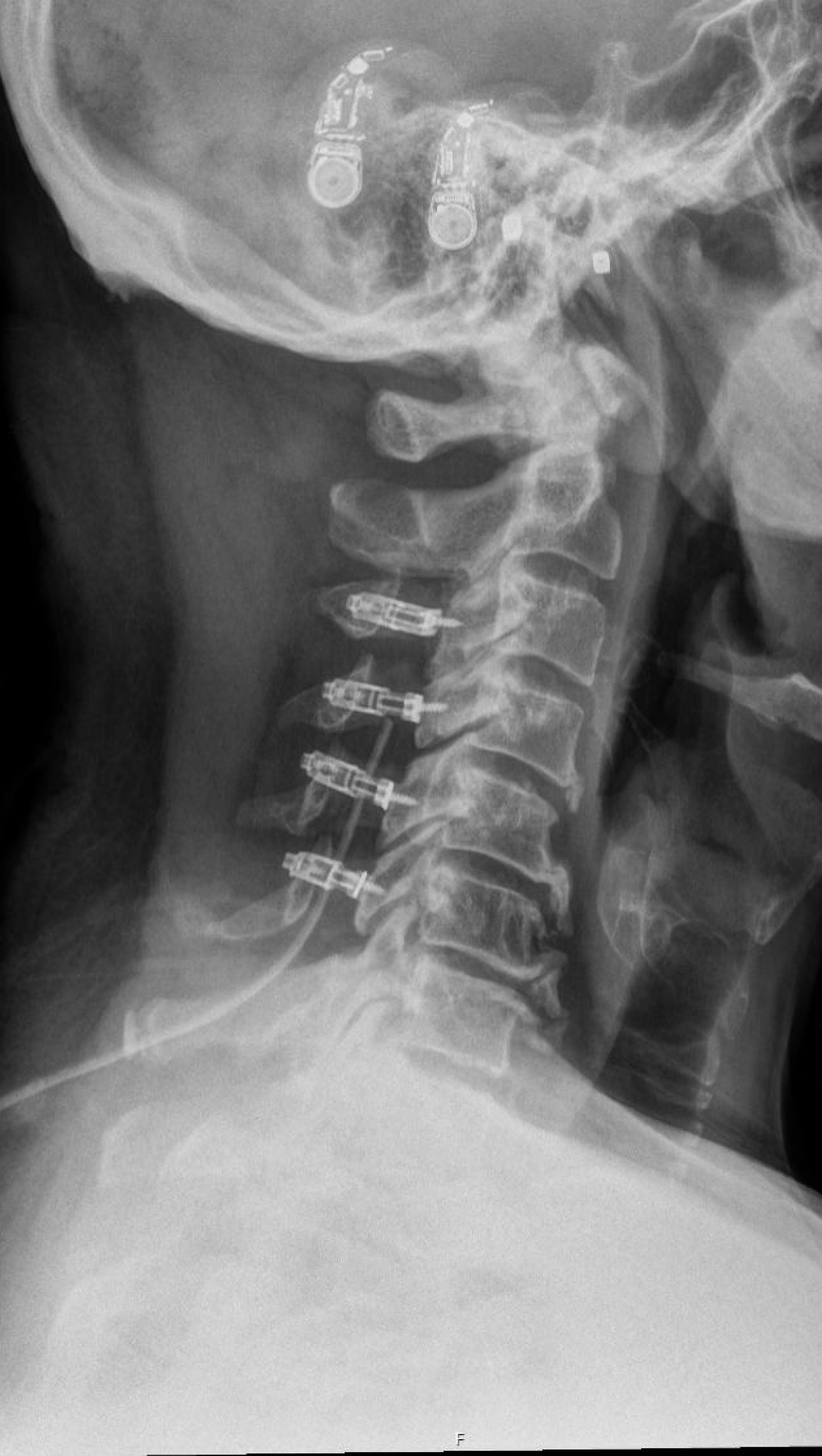
Cervical Laminoplasty in Los Angeles
Orthopedic Spine Surgeon — Long Beach & Torrance, CA
Medically reviewed by Brandon A. Ortega, MD · Last updated September 14, 2026
Cervical laminoplasty is a motion-preserving surgical treatment for multilevel cervical spinal stenosis and spinal cord compression. Unlike a traditional laminectomy and fusion, laminoplasty expands the spinal canal while preserving the posterior structures of the cervical spine and avoiding fusion. Dr. Brandon Ortega performs cervical laminoplasty in Los Angeles for appropriately selected patients with cervical myelopathy who require multilevel spinal cord decompression while maintaining as much natural cervical motion as possible.
Overview
3+ Levels
multilevel spinal cord decompression
1-2
hospital stay
6-12 Wks
average return to full activity
What Is Cervical Laminoplasty?
Cervical laminoplasty is a posterior cervical spine procedure designed to create more space for the spinal cord when it is compressed across multiple levels.
During the procedure, the lamina—the bone forming the back of the spinal canal—is carefully opened like a hinge. This expands the spinal canal and provides additional room for the spinal cord without completely removing the posterior elements or permanently fusing the vertebrae together. Small plates or other implants may be used to hold the expanded lamina in its new position.
The result is multilevel spinal cord decompression while preserving cervical stability and motion. Unlike cervical laminectomy with fusion, laminoplasty does not eliminate movement across the treated levels.
Who is a Candidate?
Who is a Candidate? Cervical laminoplasty is indicated for patients with: • Multilevel cervical spinal canal stenosis • Cervical spondylotic myelopathy • Congenital cervical stenosis • Ossification of the posterior longitudinal ligament (OPLL) The ideal candidate has preserved cervical alignment, no significant instability, and minimal mechanical neck pain.
Levels Treated
Laminoplasty is particularly useful when spinal cord compression involves three or more cervical levels. A typical reconstruction may decompress multiple levels from approximately C3 through C7, although the exact levels depend on the location of spinal cord compression and the patient’s anatomy.
The Technique
Cervical laminoplasty is performed through an incision in the back of the neck. The lamina is carefully thinned and opened on one side while maintaining a hinge on the opposite side. This creates a larger spinal canal and allows the spinal cord more room. Specialized plates may be used to maintain the expanded position.
Motion Preservation
Because the vertebrae are not intentionally fused together, laminoplasty preserves movement across the treated cervical levels. Some reduction in postoperative range of motion can occur, but significantly more motion can be retained compared with procedures that intentionally fuse multiple cervical segments.
Benefits
Why Choose Cervical Laminoplasty?
For appropriately selected patients with multilevel cervical myelopathy, laminoplasty can provide extensive spinal cord decompression without requiring a multilevel cervical fusion.
Multilevel Decompression
Laminoplasty can decompress several cervical levels through a single posterior approach, making it particularly useful for patients with extensive spinal stenosis.
Preserves Motion
The cervical vertebrae remain mobile rather than being permanently fused together. Preserving motion may be particularly valuable when three, four, or more cervical levels require treatment.
Avoids Multilevel Fusion
Because laminoplasty does not depend on bone fusion, patients avoid fusion-specific concerns such as pseudarthrosis or failure of the vertebrae to heal together.
Preserves Spinal Anatomy
Rather than completely removing the posterior cervical elements, laminoplasty reconstructs and expands the lamina to create additional room for the spinal cord.
No Fusion Consolidation
Patients do not have to wait for multiple cervical levels to biologically fuse together before the reconstruction becomes solid. Recovery instead focuses on soft-tissue healing, neurological recovery, strength, and cervical mobility.
Effective for Cervical Myelopathy
By relieving pressure across multiple levels of the spinal cord, laminoplasty can help stabilize or improve neurological symptoms caused by cervical myelopathy.
Laminoplasty vs. Fusion
Cervical Laminoplasty vs. Laminectomy and Fusion
Both cervical laminoplasty and cervical laminectomy with fusion can provide effective multilevel decompression of the spinal cord. The major difference is what happens to the cervical spine after decompression.
Cervical Laminoplasty
• Decompresses multiple cervical levels • Preserves cervical motion • Avoids multilevel fusion • No pseudarthrosis risk • Maintains posterior spinal structures • Particularly suited for multilevel stenosis with preserved alignment Potential limitations include some loss of cervical motion, reduced suitability in significant instability or substantial cervical kyphosis, and less suitability in patients with significant mechanical neck pain.
Laminectomy & Fusion
• Provides extensive multilevel spinal cord decompression • Stabilizes unstable cervical segments • Can be appropriate when significant instability is present • May be preferred when alignment requires stabilization or correction Tradeoffs include permanent loss of motion across the fused levels, the need for bone fusion, risk of pseudarthrosis, posterior instrumentation, and altered cervical biomechanics.
Which Procedure Is Right for Me?
Neither procedure is universally better. The decision depends on cervical alignment, instability, degree and location of spinal cord compression, neck pain, number of affected levels, bone quality, and overall anatomy.
When the cervical spine remains well aligned and stable, laminoplasty may allow the spinal cord to be decompressed while preserving motion. When significant instability, deformity, or mechanical neck pain is present, decompression with fusion may provide the more appropriate reconstruction.
The goal is to select the operation that provides adequate spinal cord decompression while preserving as much normal anatomy and function as safely possible.
Recovery
What to Expect After Cervical Laminoplasty
Recovery after cervical laminoplasty focuses on healing of the posterior cervical muscles, restoration of neck mobility and strength, and neurological recovery following spinal cord decompression. Unlike a cervical fusion, there is no biological fusion process that must mature before the treated levels can move.
Day of Surgery
Early Mobilization
Laminoplasty is performed under general anesthesia through an incision in the back of the neck. Neurological function is monitored after surgery, and patients typically begin sitting, standing, and walking early in recovery. The length of hospitalization depends on the extent of surgery, neurological function, pain control, mobility, and overall health.
1–2 Weeks
Early Recovery at Home
Walking is encouraged and gradually increased. Muscular soreness and stiffness in the back of the neck are common during the early recovery period because the surgery is performed through the posterior cervical muscles. Patients should avoid heavy lifting and strenuous activity while the incision and soft tissues heal.
3–6 Weeks
Restore Motion and Function
Normal daily activities gradually increase as discomfort improves. Physical therapy may begin with an emphasis on cervical range of motion, posture, shoulder-girdle strength, and restoration of the posterior cervical musculature. Patients with sedentary occupations may begin returning to work based on neurological recovery and comfort.
6–12 Weeks
Progressive Return to Activity
Strengthening and cardiovascular activity are progressively advanced. Patients may gradually return to more demanding occupational and recreational activities depending on neurological function, strength, pain, and postoperative imaging.
Long Term
Preserve Motion, Protect Neurological Function
The primary goal of laminoplasty is long-term decompression of the spinal cord while preserving as much cervical motion as possible. Neurological recovery from cervical myelopathy may continue for months after surgery, particularly when spinal cord compression existed for a prolonged period before treatment.
Ready to Find Out if Cervical Laminoplasty Is Right for You?
Cervical Laminoplasty in Los Angeles Q&A
What Is Cervical Laminoplasty?
Cervical laminoplasty is a motion-preserving posterior cervical procedure used to decompress the spinal cord across multiple levels. Instead of removing the lamina completely and performing a fusion, the lamina is opened and reconstructed in an expanded position to create additional space for the spinal cord.
What Does Laminoplasty Treat?
Cervical laminoplasty is primarily used to treat multilevel compression of the cervical spinal cord, including cervical spinal stenosis, cervical spondylotic myelopathy, degenerative cervical myelopathy, congenital cervical stenosis, OPLL, and multilevel degenerative spinal cord compression. It is primarily designed to treat spinal cord compression and myelopathy rather than isolated neck pain.
What Is Cervical Myelopathy?
Cervical myelopathy occurs when the spinal cord becomes compressed within the cervical spinal canal. Symptoms may include difficulty with balance, unsteady walking, hand clumsiness, difficulty buttoning clothing, loss of fine motor coordination, numbness or tingling, arm or hand weakness, leg weakness or heaviness, handwriting changes, and frequent dropping of objects.
Who Is a Good Candidate for Cervical Laminoplasty?
The ideal candidate generally has multilevel cervical spinal cord compression with preserved cervical lordosis, a relatively stable cervical spine, multiple levels requiring decompression, minimal mechanical axial neck pain, and no major cervical deformity requiring correction.
Who May Not Be a Candidate for Laminoplasty?
Laminoplasty may not be appropriate when there is significant cervical kyphosis, major cervical instability, severe mechanical neck pain related to degenerative instability, certain focal compressive lesions better treated from the front of the neck, deformity requiring correction, or other anatomical factors that prevent adequate posterior decompression.
How Is Cervical Laminoplasty Performed?
The procedure is performed through the back of the neck. The surgeon exposes the affected laminae and creates carefully controlled bone cuts. In an open-door laminoplasty, one side of the lamina functions as a hinge while the opposite side is opened. The spinal canal becomes wider, providing additional room for the spinal cord. Small plates may be placed to hold the laminae in the expanded position.
What Is an Open-Door Laminoplasty?
Open-door laminoplasty is one of the most commonly used laminoplasty techniques. The lamina is partially cut on one side to create a hinge and completely opened on the opposite side. The lamina then rotates outward like a door, enlarging the spinal canal. A small plate can maintain the new position while the reconstructed posterior elements heal.
How Many Levels Can Be Treated?
Laminoplasty is particularly useful when three or more cervical levels require spinal cord decompression. The exact number of levels depends on the extent of stenosis seen on MRI or CT imaging. Multilevel decompression may involve several vertebrae between C3 and C7.
Does Laminoplasty Preserve Neck Motion?
Yes. Motion preservation is one of the primary advantages of laminoplasty. Unlike laminectomy with fusion, the cervical vertebrae are not intentionally joined together. Some loss of cervical range of motion can still occur after surgery. The goal is motion preservation, not a guarantee that every degree of preoperative movement will remain unchanged.
Does Laminoplasty Require a Fusion?
No. Traditional cervical laminoplasty does not require the vertebrae to fuse together. Small plates may be used to maintain the expanded lamina, but they do not function like the screws and rods used to fuse multiple vertebral segments.
Is Laminoplasty Better Than Cervical Fusion?
Neither procedure is better for every patient. For a patient with multilevel cervical stenosis, preserved lordosis, and a stable cervical spine, laminoplasty may provide spinal cord decompression while preserving motion. For a patient with instability, substantial deformity, kyphosis, or significant mechanical neck pain, fusion may offer important advantages.
Is Laminoplasty the Same as a Laminectomy?
No. During a laminectomy, the lamina is removed to create more space for the spinal cord. During a laminoplasty, the lamina is reconstructed in an expanded position rather than completely removed. This allows the posterior spinal canal to remain covered while preserving more of the normal cervical anatomy.
Why Would I Have Laminoplasty Instead of ACDF?
ACDF is generally most useful when compression can be addressed through one or several specific disc levels from the front of the cervical spine. Laminoplasty can be especially valuable when spinal cord compression extends across several cervical levels. Rather than performing an extensive multilevel anterior reconstruction or multilevel posterior fusion, laminoplasty can decompress the region through a motion-preserving posterior approach in appropriately selected patients.
Can Laminoplasty Treat OPLL?
Yes. Laminoplasty has been extensively used to treat ossification of the posterior longitudinal ligament (OPLL) when spinal cord compression involves multiple levels and cervical alignment is appropriate for posterior decompression. The optimal approach depends on OPLL size and location, cervical alignment, number of levels involved, and other imaging characteristics.
What Are the Risks of Cervical Laminoplasty?
Potential risks include infection, bleeding, dural tear, nerve injury, spinal cord injury, C5 nerve palsy, persistent or new neck pain, loss of cervical range of motion, changes in cervical alignment, failure of adequate neurological improvement, recurrent or progressive stenosis, and the need for additional surgery.
What Is C5 Palsy?
C5 palsy is a recognized complication of cervical spinal cord decompression. It typically causes weakness of the deltoid and sometimes the biceps after surgery and can occur even when the spinal cord has been successfully decompressed. Many cases improve with time, although recovery can vary.
Will My Myelopathy Completely Go Away After Surgery?
The primary purpose of surgery for cervical myelopathy is to decompress the spinal cord and prevent continued neurological deterioration. Many patients also experience meaningful neurological improvement after decompression. Recovery depends on severity and duration of compression, preoperative neurological function, age, and whether permanent spinal cord changes are already present.
How Long Is Recovery After Cervical Laminoplasty?
Walking generally begins early following surgery. The first several weeks focus on incision healing, pain control, mobility, and recovery of the posterior cervical muscles. Activity and exercise are progressively advanced over the following weeks. Neurological recovery may continue for several months after the spinal cord has been decompressed.
Will I Need a Neck Brace?
Yes. A cervical collar is typically worn for at least 6 weeks after cervical laminoplasty to support soft-tissue healing and protect the posterior cervical musculature during the early recovery period.Because laminoplasty does not require fusion, the brace is used primarily to support healing of the surgical tissues rather than to allow the vertebrae to fuse together.
Can I Exercise After Cervical Laminoplasty?
Yes. Walking begins early and more demanding exercise is progressively introduced during recovery. Maintaining cervical mobility and rebuilding posterior cervical and shoulder-girdle strength are important components of rehabilitation. The timing of weightlifting, sports, and strenuous exercise depends on neurological recovery and postoperative healing.
Can I Return to an Active Lifestyle After Laminoplasty?
For appropriately selected patients, returning to an active and independent lifestyle is an important goal of surgery. Because laminoplasty preserves cervical motion rather than intentionally fusing multiple levels, it can be attractive when extensive decompression is required but fusion may not be necessary.
Does Insurance Cover Cervical Laminoplasty?
Cervical laminoplasty may be covered by health insurance when medically necessary for treatment of cervical spinal cord compression or myelopathy. Coverage depends on the insurance policy, diagnosis, imaging findings, symptoms, and authorization requirements.
Where Can I Get Cervical Laminoplasty in Los Angeles?
Patients considering cervical laminoplasty should be evaluated by a spine surgeon experienced in both motion-preserving and fusion-based cervical surgery. Dr. Brandon Ortega evaluates patients in Long Beach and Torrance, California, serving patients throughout Los Angeles and Southern California.
Why Choose Ortega Spine?
Fellowship-Trained Expertise
Advanced subspecialty training in complex, minimally invasive, and motion-preserving spine surgery.
Motion-Preservation Techniques
Cervical and lumbar disc replacement designed to relieve pain while preserving motion at the treated level.
Conservative Care First
Care begins with the least invasive effective treatment, reserving surgery for when nonoperative options are no longer sufficient.
Two Convenient Locations
Personalized spine care in Long Beach and Torrance, conveniently serving patients throughout the greater Los Angeles area.

About Dr. Ortega
Brandon A. Ortega, MD, is a board-certified, fellowship-trained orthopedic spine surgeon who provides comprehensive and personalized spinal care to adults in Torrance and Long Beach, California. His dedication to helping each patient regain mobility, reduce pain, and improve their quality of life has earned the respect of everyone in the community struggling with neck and back pain.
Consultation
Get Expert Care with Cervical Laminoplasty in Los Angeles
Request an appointment with Brandon A. Ortega, MD, and our team will contact you to schedule a personalized spine consultation.
Prefer to call? Contact us.