
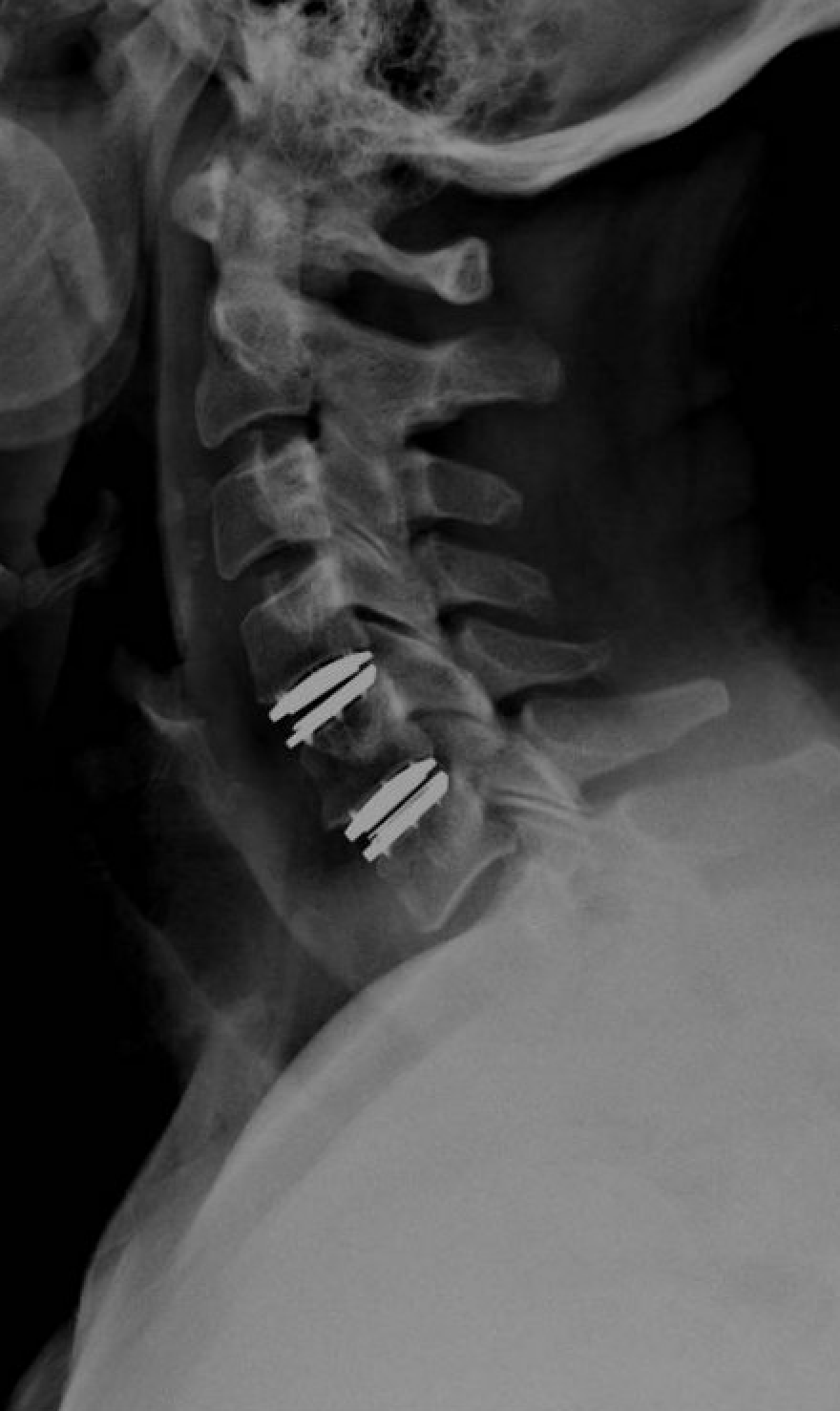
Cervical Disc Replacement in Los Angeles
Orthopedic Spine Surgeon — Long Beach & Torrance, CA
Medically reviewed by Brandon A. Ortega, MD · Last updated September 8, 2026
Cervical disc replacement (CDR), also known as cervical artificial disc replacement (ADR), is a motion-preserving surgical option for select patients with symptomatic cervical degenerative disc disease or disc herniation. Dr. Brandon Ortega performs cervical disc replacement in Los Angeles for appropriate candidates seeking an alternative to anterior cervical discectomy and fusion (ACDF). During the procedure, the damaged disc is removed and replaced with an artificial disc designed to maintain motion, restore disc height, relieve pressure on the spinal cord or nerves, and improve neck and arm symptoms.
Overview
> 95%
patient satisfaction at 10-year follow-up
< 1
night hospital stay
< 6 Wks
average return to full activity
What is Cervical Disc Replacement
Cervical disc replacement (CDR) is a surgical procedure that replaces a degenerated or herniated disc in the neck with an articulating artificial implant. When a cervical disc fails, it can compress nerve roots or the spinal cord, producing neck pain, arm pain (radiculopathy), numbness, tingling, or weakness. CDR addresses the root cause by removing the diseased disc and restoring normal disc height, nerve space, and spinal alignment.
Unlike anterior cervical discectomy and fusion (ACDF), CDR preserves motion at the treated level. The prosthetic disc replicates natural disc mechanics, allowing flexion, extension, and rotation, rather than permanently locking adjacent vertebrae together.
Who is a Candidate?
Adults with cervical disc herniation or degenerative disc disease causing radiculopathy or myelopathy, after failing conservative care.
Levels Treated
Most commonly between C3–C7. Single and two-level CDR are both options depending on the extent of disc disease.
The Implant
Modern CDR devices use a metal-on-polymer or metal-on-metal articulating surface that replicates natural disc motion in all planes.
FDA-Approved
Multiple CDR devices carry FDA approval with long-term IDE clinical trial data supporting safety and efficacy as an alternative to fusion.
Benefits
Why choose motion preservation?
For appropriately selected patients, CDR offers clinically meaningful advantages over fusion, particularly for active individuals who want to protect their spine's long-term health and maintain an unrestricted lifestyle.
Preserved Range of Motion
The treated level continues to move naturally, maintaining full biomechanical function in daily activity, sport, and work.
Reduced Adjacent Segment Disease
By maintaining motion at the treated level, CDR reduces abnormal stress on adjacent discs, a known long-term consequence of fusion.
No Bone Graft Required
CDR eliminates bone grafting, avoiding donor site pain, harvest complications, and the risk of pseudarthrosis (non-union).
Faster Recovery
Without fusion consolidation to wait for, patients often return to light activity sooner and follow a more predictable recovery course.
Durable Long-Term Outcomes
FDA IDE trials show CDR maintains superior or equivalent outcomes versus ACDF at 7 and 10-year follow-up across multiple device platforms.
Multi-Level Capability
CDR can be performed at one or two levels, offering a motion-preserving option where fusion has historically dominated.
CDR vs. Fusion
Cervical Disc Replacement vs ACDF
Both procedures remove the damaged disc and decompress the nerves. The defining difference is what happens to that level of the spine afterward, and how that shapes your health over the decades ahead.
Cervical Disc Replacement
Dr. Ortega’s Preference for Eligible Patients ✓ Preserves motion at the treated level ✓ Lower adjacent segment disease at 10 years ✓ No bone graft -> no pseudarthrosis risk ✓ Faster return to unrestricted activity ✓ Performable at 1-2 levels – Requires intact facet joints and endplates – Not indicated in spondylosis or instability
Anterior Cervical Discectomy & Fusion
✓ 50+ year established clinical track record ✓ Applicable across a broader pathology ✓ Better suited for instability or deformity – Permanently eliminates motion – Higher adjacent segment disease rates – Fusion consolidation takes 3–6 months – Risk of pseudarthrosis, especially multilevel
The right choice depends on your anatomy, degree of spondylosis, and the levels involved. Dr. Ortega reviews your imaging carefully to recommend the approach most likely to deliver lasting relief, and protect the segments above and below for years to come.
Recovery
What to Expect After Cervical Disc Replacement
CDR recovery is often more straightforward than patients anticipate. Because there is no fusion to wait for, recovery is driven by soft tissue healing and neurological improvement, not bone consolidation. Most patients are surprised by how quickly they feel relief from their arm and neck symptoms.
Day of Surgery
Same-Day or 1-Night Stay
CDR is performed under general anesthesia through a small anterior incision in the neck. Many patients are discharged the same day or after one overnight stay.
1-2 Weeks
Early Recovery at Home
Light walking begins immediately. Arm and neck pain typically starts to improve within days as nerve compression is relieved. A soft collar may be worn for comfort.
3-6 Weeks
Gradual Return to Activity
Driving and light desk work typically resume at 2–4 weeks. Physical therapy begins to restore cervical strength and range of motion. Most patients notice significant functional improvement by this stage.
6–12 Weeks
Full Return to Activity
The majority of patients return to unrestricted occupational and recreational activity within 6–12 weeks. Athletes and active patients often reach sport-specific milestones within this window.
Long Term
Durable Relief, Natural Motion
The prosthetic disc is designed for a lifetime of use. Long-term follow-up at 7 and 10 years shows sustained neurological improvement and maintained segmental motion at the implanted level.
Ready to Find Out if Cervical Disc Replacement is Right for You?
Cervical Disc Replacement in Los Angeles Q&A
What Is Cervical Disc Replacement?
Cervical disc replacement, also called cervical artificial disc replacement (ADR), is a motion-preserving surgery that removes a damaged or herniated disc in the neck and replaces it with an artificial disc. The goal is to relieve pressure on the spinal cord or nerves while maintaining motion at the treated level.
Who Is a Candidate for Cervical Disc Replacement?
Candidates are typically patients with symptomatic cervical degenerative disc disease or a cervical disc herniation causing neck pain, arm pain, numbness, weakness, radiculopathy, or spinal cord compression that has not improved with appropriate nonoperative treatment. Candidacy depends on factors such as the location of the disease, spinal alignment and stability, facet joint health, bone quality, and the degree of degeneration.
How Is Cervical Disc Replacement Different From ACDF?
Cervical disc replacement is designed to preserve motion at the treated level. Anterior cervical discectomy and fusion (ACDF) removes the damaged disc and permanently joins the adjacent vertebrae. Disc replacement may be an alternative to fusion in appropriately selected patients, while ACDF may be more appropriate when significant instability, deformity, poor bone quality, advanced facet arthritis, or other contraindications to disc replacement are present.
Is Cervical Disc Replacement Better Than Fusion?
Neither cervical disc replacement nor ACDF is the best option for every patient. Cervical disc replacement may offer advantages in appropriately selected patients, including preservation of motion at the treated level and avoidance of fusion. The most appropriate procedure depends on the patient's diagnosis, anatomy, spinal stability, facet joints, number of affected levels, and treatment goals.
Can Two Cervical Discs Be Replaced?
Yes. Two-level cervical disc replacement may be performed in appropriately selected patients with symptomatic disease involving two adjacent cervical discs. Certain FDA-approved artificial cervical discs are indicated for treatment at two contiguous levels. Eligibility depends on the specific levels involved, implant indications, anatomy, spinal stability, facet joint condition, and bone quality.
What Conditions Can Cervical Disc Replacement Treat?
Cervical disc replacement is commonly used to treat cervical degenerative disc disease, cervical disc herniation, cervical radiculopathy, and certain cases of spinal cord compression or cervical myelopathy caused by disc-level pathology. It is not appropriate for every cause of neck or arm symptoms, making an accurate diagnosis and careful patient selection essential.
How Is Cervical Disc Replacement Surgery Performed?
Cervical disc replacement is generally performed through a small incision in the front of the neck. The damaged disc and any compressive disc or bone material are removed to relieve pressure on the spinal cord and nerves. The disc space is then restored, and an artificial cervical disc is placed between the vertebrae to preserve motion at the treated level.
How Long Is Recovery After Cervical Disc Replacement?
Patients are typically encouraged to begin walking shortly after surgery and gradually increase their activity during recovery. Many patients return to light daily activities relatively quickly, while work, exercise, and more strenuous activities are resumed progressively based on healing and the surgeon's recommendations. Recovery varies depending on the number of levels treated, the patient's overall health, and the physical demands of their activities.
How Long Do Artificial Cervical Discs Last?
Modern artificial cervical discs are designed for long-term implantation, and clinical studies have demonstrated durable outcomes at long-term follow-up. However, no artificial implant can be guaranteed to last indefinitely. Implant longevity may depend on factors such as positioning, anatomy, activity level, bone quality, and the condition of the surrounding cervical spine.
What Are the Risks of Cervical Disc Replacement?
As with any spine surgery, cervical disc replacement has potential risks. These may include infection, bleeding, nerve or spinal cord injury, swallowing difficulty, voice changes, implant migration or wear, heterotopic bone formation, persistent symptoms, and the possibility of additional surgery. An individualized evaluation is necessary to determine whether the potential benefits outweigh the risks.
Can I Exercise After Cervical Disc Replacement?
Yes. Returning to an active lifestyle is often an important goal of cervical disc replacement. Walking usually begins early after surgery, while strengthening, cardiovascular exercise, weight training, and other activities are introduced progressively based on healing and the surgeon's recommendations.
Can I Return to Sports After Cervical Disc Replacement?
Many appropriately selected patients return to recreational exercise and sports following recovery from cervical disc replacement. The timing and type of activity depend on healing, neurological recovery, conditioning, the number of levels treated, and the physical demands of the sport.
What Is the Success Rate of Cervical Disc Replacement?
Clinical studies of appropriately selected patients have demonstrated significant improvements in neck pain, arm pain, neurological symptoms, and function following cervical artificial disc replacement, while maintaining motion at the treated level. Individual outcomes vary based on the underlying diagnosis, patient selection, surgical technique, and other medical and spinal factors.
What Can Disqualify Someone From Cervical Disc Replacement?
Cervical disc replacement may not be appropriate for patients with conditions such as significant cervical instability, advanced facet joint arthritis, severe osteoporosis, certain spinal deformities, infection, severe spondylosis, or anatomy that does not allow safe placement of an artificial disc. Each patient requires an individualized evaluation to determine whether disc replacement or another treatment is more appropriate.
Does Insurance Cover Cervical Disc Replacement?
Insurance coverage for cervical disc replacement varies by insurance carrier, diagnosis, number of levels being treated, implant, and the patient's individual policy. Prior authorization is often required. The surgeon's office can review coverage requirements and help determine whether cervical artificial disc replacement may be covered.
Where Can I Get Cervical Disc Replacement in Los Angeles?
Patients considering cervical disc replacement in Los Angeles should seek evaluation from a spine surgeon experienced in both motion-preserving surgery and cervical fusion. A comprehensive evaluation can determine whether cervical disc replacement, ACDF, hybrid surgery, continued nonoperative treatment, or another treatment option is most appropriate.
Why Choose Ortega Spine?
Fellowship-Trained Expertise
Advanced subspecialty training in complex, minimally invasive, and motion-preserving spine surgery.
Motion-Preservation Techniques
Cervical and lumbar disc replacement designed to relieve pain while preserving motion at the treated level.
Conservative Care First
Care begins with the least invasive effective treatment, reserving surgery for when nonoperative options are no longer sufficient.
Two Convenient Locations
Personalized spine care in Long Beach and Torrance, conveniently serving patients throughout the greater Los Angeles area.

About Dr. Ortega
Brandon A. Ortega, MD, is a board-certified, fellowship-trained orthopedic spine surgeon who provides comprehensive and personalized spinal care to adults in Torrance and Long Beach, California. His dedication to helping each patient regain mobility, reduce pain, and improve their quality of life has earned the respect of everyone in the community struggling with neck and back pain.
Consultation
Get Expert Care with Cervical Disc Replacement in Los Angeles
Request an appointment with Brandon A. Ortega, MD, and our team will contact you to schedule a personalized spine consultation.
Prefer to call? Contact us.