
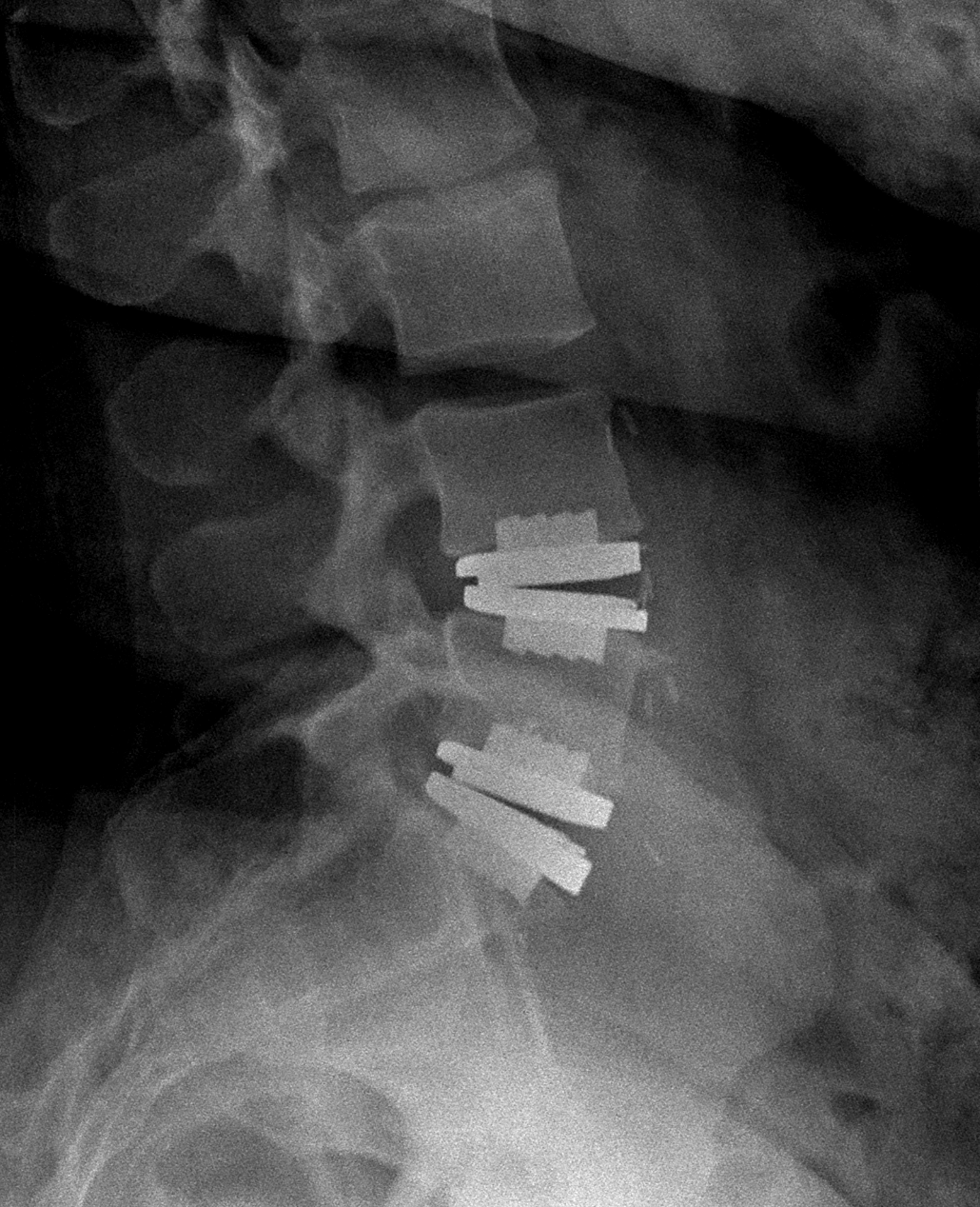
Lumbar Disc Replacement in Los Angeles
Orthopedic Spine Surgeon — Long Beach & Torrance, CA
Medically reviewed by Brandon A. Ortega, MD · Last updated August 21, 2026
Lumbar disc replacement (LDR), also known as lumbar artificial disc replacement (ADR), is a motion-preserving surgical option for select patients with painful lumbar degenerative disc disease. Dr. Brandon Ortega performs lumbar disc replacement in Los Angeles for appropriate candidates seeking an alternative to spinal fusion. During the procedure, the damaged disc is removed and replaced with an artificial disc designed to maintain spinal motion, restore disc height, and relieve disc-related low back pain.
Overview
> 90%
report significant pain reduction
< 1-2
nights average hospital stay
< 6-12 Wks
average return to full activity
What Is a Lumbar Disc Replacement?
Lumbar disc replacement (LDR) treats degenerative disc disease in the lower back by removing the diseased disc through an anterior (abdominal) approach and replacing it with a precisely sized prosthetic device. When a lumbar disc collapses, the resulting loss of disc height and abnormal segmental motion can compress nerves and produce chronic low back pain and leg pain (sciatica). LDR addresses this directly at the source. Unlike lumbar fusion, LDR maintains segmental mobility, the lumbar spine continues to bend, extend, and rotate through the treated level rather than transferring all motion to adjacent segments. This distinction has meaningful long-term implications for adjacent disc health and functional quality of life.
Who is a Candidate?
Patients with one- or two-level lumbar DDD with predominantly axial low back pain who have failed at least 6 weeks of conservative treatment.
Levels Treated
Most commonly L4–L5 and L5–S1, the segments that bear the greatest mechanical load in the lumbar spine.
The Approach
Performed through a retroperitoneal anterior approach with a vascular access surgeon, allowing direct disc access without disturbing posterior muscles or neural structures.
FDA-Approved
The ProDisc-L devices carry FDA approval with robust IDE trial data demonstrating non-inferiority and superiority to fusion in select populations.
Benefits
The Case for Lumbar Motion Preservation
For appropriately selected patients, LDR delivers equivalent or superior pain relief compared to fusion while protecting the long-term integrity of the lumbar spine. The benefits are most pronounced for active patients with isolated disc disease at one or two levels.
Maintained Lumbar Mobility
Patients retain bending and rotation at the treated level, supporting more natural movement in daily activity, exercise, and sport.
Adjacent Disc Protection
Fusion concentrates stress at the levels above and below. LDR distributes load more physiologically, reducing adjacent disc degeneration over time.
No Posterior Instrumentation
LDR avoids pedicle screws and rods of posterior fusion, reducing hardware complications and preserving future surgical options if ever needed.
Equivalent or Superior Outcomes
FDA IDE trial data at 5-7 years shows LDR provides equivalent or superior results in pain, function, and satisfaction compared to ALIF fusion.
Lower Reoperation Rates
By avoiding fusion complications like pseudarthrosis and adjacent segment disease, LDR patients have lower reoperation rates at 5–10 years.
Improved Quality of Life
Patients consistently report higher satisfaction with physical function and ability to return to recreational and occupational activities compared to lumbar fusion cohorts.
LDR vs. Fusion
Lumbar Disc Replacement vs Anterior Lumbar Interbody Fusion
LDR and Anterior Lumbar Interbody Fusion (ALIF) both approach the spine from the front and address the diseased disc. The difference lies in what follows, mobility or immobility, and what that means for the rest of your spine over time.
Lumbar Disc Replacement (LDR)
Dr. Ortega’s Preference for Eligible Patients ✓ Preserves motion at L4–L5 or L5–S1 ✓ No bone graft -> no pseudarthrosis risk ✓ Lower adjacent segment disease burden ✓ No posterior hardware required ✓ Lower long-term reoperation rates – Requires intact posterior elements (facets) – Not indicated in spondylolisthesis (> grade 1)
Anterior Lumbar Interbody Fusion (ALIF)
✓ Addresses spondylolisthesis and instability ✓ Strong deformity correction capability ✓ Applicable across a broader pathology – Permanently eliminates motion – Higher adjacent disc degeneration risk – Often requires posterior instrumentation – Longer recovery due to fusion consolidation
Not every patient qualifies for LDR. Patients with significant facet arthritis, spondylolisthesis (> grade 1), prior posterior fusion, or osteoporosis are often better served by fusion. Dr. Ortega's evaluation includes standing X-rays, MRI/CT and DEXA to determine the approach most likely to produce the best long-term outcome for your specific anatomy and pathology.
Recovery
What to Expect After Lumbar Disc Replacement
LDR recovery follows a structured progression. Because there is no bone fusion to wait for, milestones are determined by anterior incision healing, soft tissue recovery, and the gradual return to loading the lumbar spine. Most patients are pleased by how quickly their leg pain and back pain begin to resolve.
Day of Surgery
Hospital Admission, < 1-2 Nights
LDR is performed through a retroperitoneal anterior incision with an access surgeon. A short hospital stay of 1-2 nights is typical while early mobilization begins.
1-2 Weeks
Early Mobilization at Home
Walking is encouraged from day one. Back and leg pain often begin to improve quickly. Restrictions on bending, lifting, and twisting are in place to protect the implant during early healing.
3-6 Weeks
Expanding Activity
Driving typically resumes around 3–4 weeks. Structured physical therapy begins, focused on core activation and lumbar stabilization. Many patients return to desk-based work during this period.
8-12 Weeks
Return to Rull Activity
Most patients achieve unrestricted physical activity, including exercise, recreational sport, and manual work by 8–12 weeks. Physical therapy continues for strength optimization through this period.
Long Term
Motion Maintained, Adjacent Spine Protected
The prosthetic disc is engineered for decades of use. Long-term follow-up demonstrates maintained implant position, preserved segmental motion, and lower rates of clinically significant adjacent segment disease compared to fusion cohorts.
Ready to Find Out if Lumbar Disc Replacement is Right For You?
Lumbar Disc Replacement in Los Angeles Q&A
What Is Lumbar Disc Replacement?
Lumbar disc replacement, also called lumbar artificial disc replacement (ADR), is a motion-preserving surgery that removes a damaged spinal disc and replaces it with an artificial disc. The goal is to relieve disc-related low back pain while maintaining movement at the treated level.
Who Is a Candidate for Lumbar Disc Replacement?
Candidates are typically patients with symptomatic lumbar degenerative disc disease whose pain has not improved with appropriate nonoperative treatment. Candidacy depends on factors such as the source of pain, spinal stability, facet joint health, bone quality, alignment, and the location and severity of disc degeneration.
How Is Lumbar Disc Replacement Different From Spinal Fusion?
Lumbar disc replacement is designed to preserve motion at the treated spinal level. Lumbar fusion permanently joins adjacent vertebrae and eliminates motion at that segment. Disc replacement may be an alternative to fusion in appropriately selected patients, while fusion may be more appropriate when significant instability, deformity, poor bone quality, or advanced facet arthritis is present.
Is Lumbar Disc Replacement Better Than Fusion?
Neither procedure is best for every patient. Lumbar disc replacement may offer advantages for appropriately selected patients, including preservation of spinal motion and avoidance of fusion at the treated level. The best procedure depends on the patient's anatomy, diagnosis, symptoms, spinal stability, facet joints, and treatment goals.
Can Two Lumbar Discs Be Replaced?
Yes. Two-level lumbar disc replacement may be performed in appropriately selected patients with symptomatic degeneration involving two adjacent lumbar discs. Whether a patient qualifies depends on the specific levels involved, implant indications, spinal anatomy, bone quality, facet joint condition, and overall spinal stability.
What Conditions Can Lumbar Disc Replacement Treat?
Lumbar disc replacement is primarily used to treat painful lumbar degenerative disc disease and discogenic low back pain in carefully selected patients. It is not intended to treat every cause of back pain, which is why identifying the source of the patient's symptoms is an important part of the evaluation.
How Is Lumbar Disc Replacement Surgery Performed?
Lumbar disc replacement is generally performed through an anterior approach, meaning the surgeon reaches the lumbar spine through the abdomen rather than through the muscles of the lower back. The damaged disc is removed, the disc space is restored, and an artificial disc is positioned between the vertebrae to maintain motion.
How Long Is Recovery After Lumbar Disc Replacement?
Patients are typically encouraged to begin walking soon after surgery and gradually increase their activity during recovery. Many patients make substantial progress over the first several weeks, with return to more demanding activities occurring gradually over the following months. Recovery varies depending on the individual, number of levels treated, overall health, and activity demands.
How Long Do Artificial Lumbar Discs Last?
Modern artificial lumbar discs are designed for long-term implantation. Clinical studies have demonstrated durable outcomes at long-term follow-up, although no artificial implant can be guaranteed to last indefinitely. Implant longevity depends on several factors, including positioning, anatomy, activity level, bone quality, and the condition of the surrounding spine.
What Are the Risks of Lumbar Disc Replacement?
As with any spine surgery, lumbar disc replacement has potential risks, including infection, bleeding, nerve or vascular injury, implant migration or wear, persistent symptoms, heterotopic bone formation, and the possibility of additional surgery. An individualized surgical evaluation is necessary to determine whether the potential benefits outweigh the risks.
Can I Exercise After Lumbar Disc Replacement?
Yes. Returning patients to an active lifestyle is often an important goal of lumbar disc replacement. Walking usually begins early, while strengthening, cardiovascular exercise, sports, and heavier activities are introduced progressively based on healing and the surgeon's recommendations.
Can I Return to Sports After Lumbar Disc Replacement?
Many appropriately selected patients return to recreational exercise and sports after recovery from lumbar disc replacement. The timing and type of activity depend on healing, conditioning, the number of levels treated, and the physical demands of the sport.
What Is the Success Rate of Lumbar Disc Replacement?
Studies of appropriately selected patients have demonstrated significant improvements in pain and function following lumbar artificial disc replacement, along with preservation of motion at the treated level. Individual outcomes vary depending on diagnosis, patient selection, surgical technique, and other medical and spinal factors.
What Can Disqualify Someone From Lumbar Disc Replacement?
Lumbar disc replacement may not be appropriate for patients with conditions such as significant spinal instability, advanced facet joint arthritis, severe osteoporosis, certain spinal deformities, infection, or other anatomical conditions that make an artificial disc unsuitable. Each patient requires an individualized evaluation.
Does Insurance Cover Lumbar Disc Replacement?
Insurance coverage for lumbar disc replacement varies by insurance carrier, diagnosis, treatment level, implant, and the patient's individual policy. Prior authorization is often required. The surgeon's office can review coverage requirements and help determine whether the procedure may be covered.
Where Can I Get Lumbar Disc Replacement in Los Angeles?
Patients considering lumbar disc replacement in Los Angeles should seek evaluation from a spine surgeon experienced in both motion-preserving surgery and spinal fusion. A comprehensive evaluation can determine whether disc replacement, fusion, continued nonoperative treatment, or another treatment option is most appropriate.
Why Choose Ortega Spine?
Fellowship-Trained Expertise
Advanced subspecialty training in complex, minimally invasive, and motion-preserving spine surgery.
Motion-Preservation Techniques
Cervical and lumbar disc replacement designed to relieve pain while preserving motion at the treated level.
Conservative Care First
Care begins with the least invasive effective treatment, reserving surgery for when nonoperative options are no longer sufficient.
Two Convenient Locations
Personalized spine care in Long Beach and Torrance, conveniently serving patients throughout the greater Los Angeles area.

About Dr. Ortega
Brandon A. Ortega, MD, is a board-certified, fellowship-trained orthopedic spine surgeon who provides comprehensive and personalized spinal care to adults in Torrance and Long Beach, California. His dedication to helping each patient regain mobility, reduce pain, and improve their quality of life has earned the respect of everyone in the community struggling with neck and back pain.
Consultation
Get Expert Care with Lumbar Disc Replacement in Los Angeles
Request an appointment with Brandon A. Ortega, MD, and our team will contact you to schedule a personalized spine consultation.
Prefer to call? Contact us.